


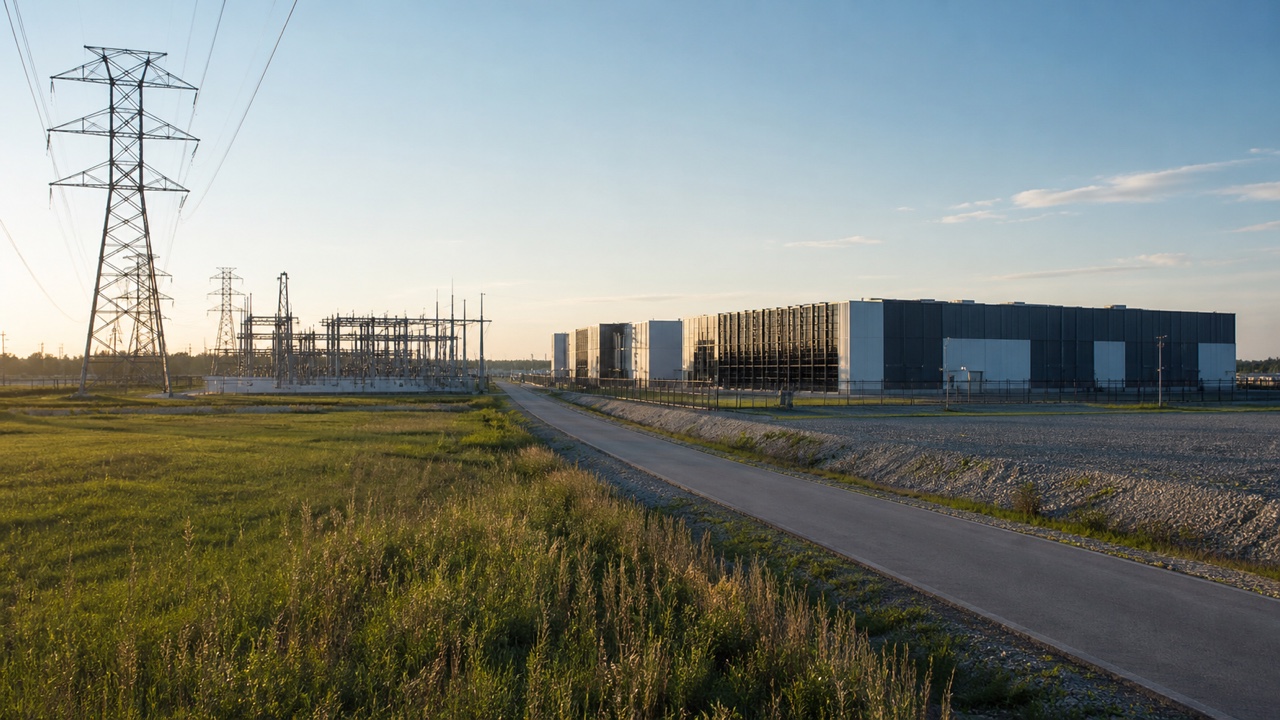
When people talk about artificial intelligence, the conversation usually starts with chips, servers and computing power. My instinct is different. I start with the property. Before I believe a data center site is real, I want to know when electricity can actually reach it, whether the land is controlled and whether the project can truly be built.
That comes from spending years looking at real estate and complex deals. Technology can move quickly, but land, utilities, roads, zoning and construction still move at physical speed. A project may sound extraordinary while the things determining whether it succeeds are very ordinary.
Power Has to Be Real
The demand for power is undeniable. Lawrence Berkeley National Laboratory reported that American data centers used 192 terawatt-hours of electricity in 2024—about 4.7 percent of all electricity used in the country. Its reference case projects 649 terawatt-hours by 2030, or 11.8 percent of national electricity use.
One detail in that report caught my attention. The lab revised its earlier historical estimates slightly downward because fewer GPUs were shipped in 2023 and 2024 than previously assumed. Even careful forecasts can run ahead of what actually gets installed. That is why I separate a projected need from a project that is ready to move.
Power is also local. A region may have plenty of electricity on paper while a particular site lacks the substation capacity or transmission route it needs. Interconnection—the process for connecting a large new customer to the grid—determines what equipment must be added, who must build it and how long that work could take. Power on paper is not power at the plug.
Fiber Has to Hold
Power is the first gate, but it is not the only one. A site also needs high-capacity fiber with physically separate routes, so one cut does not isolate the facility. Power makes the site possible; fiber makes it usable.
In June, the Federal Energy Regulatory Commission called the issue “speed to power.” That phrase gets directly to the point. The important question is not simply how many megawatts a developer wants. It is when those megawatts can be delivered.
The same discipline applies to demand. PJM’s 2026 forecast still projects substantial long-term growth, but PJM reduced parts of its near-term forecast after utilities did a better job of identifying which large-load requests had firm commitments behind them. Demand can be real while some proposed projects are not. An announcement is not an electrical connection.
Land Has to Work
Then there is the land itself. Acreage alone tells me very little. I want to know whether the use is permitted, whether construction traffic can reach the site, whether new power must cross land the developer does not control and whether the project fits the community around it. A parcel that looks perfect on a map can fail on any one of those questions.
FERC Commissioner David Rosner has pointed to physical site control as one way to distinguish serious large-load proposals from speculative ones. In plain English, the party asking for power should have a real path to the property behind the request. It sounds obvious, but obvious things are often skipped when a market is moving quickly.
This is why I do not assume that the largest parcel or the cheapest land is the best site. The stronger opportunity is often the property with a credible path to power, clear site control, workable approvals and a plan that respects the surrounding community.
AI may be changing at digital speed, but infrastructure does not. The cloud is not weightless. It rests on land, it runs on power and it has to live in a real community. Those are the questions that tell me whether a data center site is real or just an exciting headline.


I like to spend my time giving back with organizations that focus on mentoring aspiring entrepreneurs. I have supported after school programs that focus on entrepreneurial and global initiatives in local primary schools. I recently extended my mentoring to include students at Case Western Reserve University.